
Houses · Townhouses · Holiday homes
Residential Solar Panel Cleaning
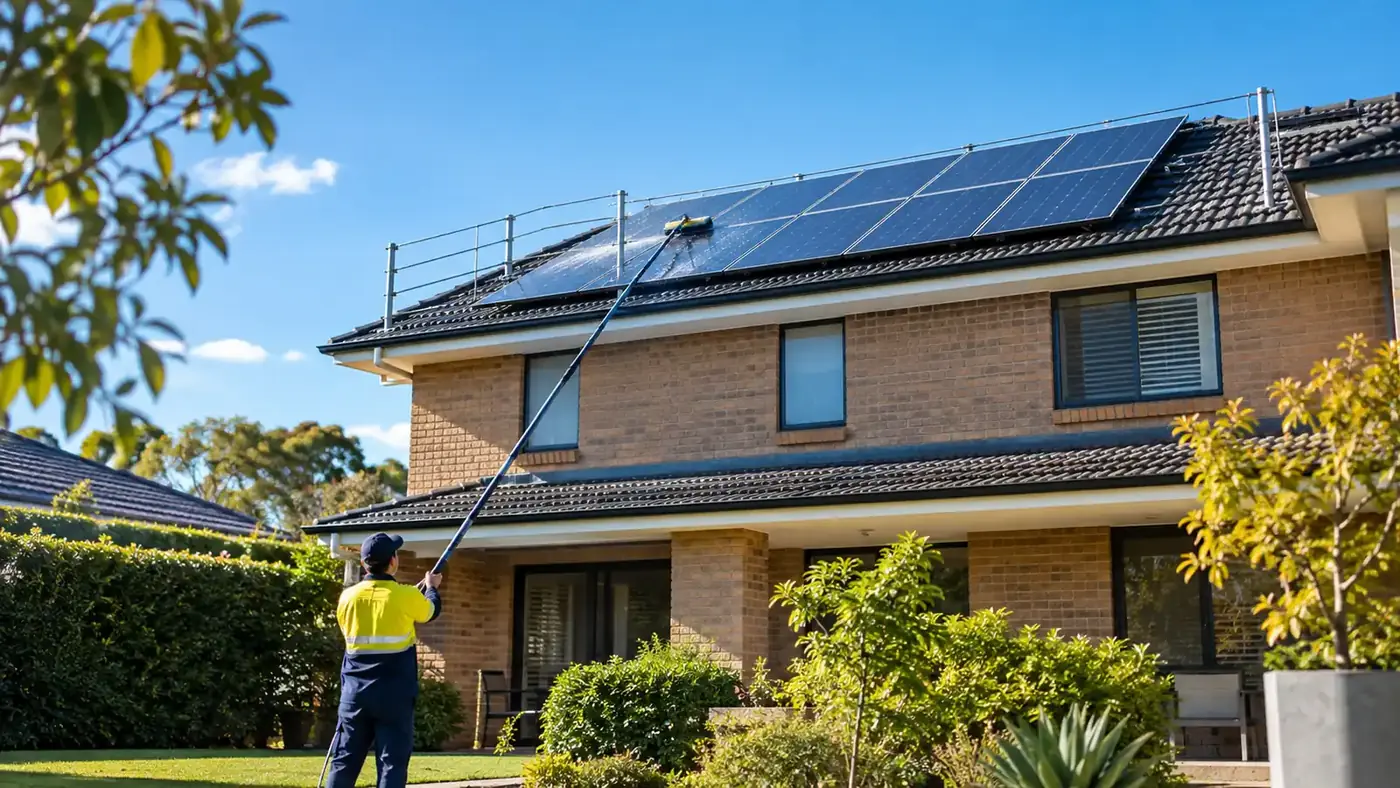
Our residential solar panel cleaning service looks after the arrays on Melbourne houses, townhouses and holiday homes, one roof at a time. We wash the glass with purified water and a soft brush on a long pole, almost always from your yard, so the tiles stay whole and nobody leans over a gutter. Most homes are finished inside a morning.
Home systems gather dust, pollen and droppings that rain rarely shifts, and a grimy lower edge can shade a whole row of cells. The wash itself looks simple. Doing it without scratching the coating, upsetting a warranty or cracking a tile is the part you are paying for. For the method, prices and suburbs in one place, see our guide to solar panel cleaning in Melbourne.
- Worked from your lawn or driveway wherever a pole reaches
- Harmless to pets, ponds and the veggie patch
- Dated before and after photos in your inbox
- Panels
- 14 to 26
- Time on site
- 1 to 2 hours
- Access
- Pole from the ground
- You at home
- Not needed
The visit
How does a residential solar panel cleaning service work?
A residential solar panel cleaning service washes every panel on your roof with purified water and a soft brush, clears the grime that builds along the lower edge, then photographs the result. On most Melbourne homes the whole visit happens from the ground and takes one to two hours.
Cleaning home solar panels properly is less about scrubbing and more about order. We start at the top row and work down, so dirty runoff never crosses glass that is already done, and each string gets rinsed before the brush moves on. Anything baked on is soaked and left for a few minutes rather than attacked.
There is not much you need to do beforehand. Leave the side gate open, keep the dog inside for the morning, and move anything fragile from directly under the eaves, such as pot plants or a bike. If the panels feed a battery, leave it alone; washing the glass does not touch the wiring.
Before any water goes up, we walk the yard. That quick look shows where the pole can reach, whether the downpipes empty onto a bed of seedlings, and whether birds have moved in under the array. Anything out of the ordinary goes into your report with a photo beside it.
- ArrivePark out the front and say hello if you are home.
- Walk the yardGate, pets, garden beds and where the pole can stand.
- Before photosEach section of the array, from spots we can repeat later.
- Top row downPure water through a soft brush, one string at a time.
- Rinse and checkA last rinse, then a look along the glass for anything missed.
- Report sentAfter photos taken, gate latched, report emailed.
Sample timing for an 18-panel single storey home. Bigger or grimier arrays take longer, and we give you an expected finish time when we confirm the booking.
Want to have a go yourself first?
Plenty of people rinse a low, ground-floor array with a hose and a soft broom, and that is fine between cleans. Read our guide on how to clean solar panels before you start, and never climb onto the roof to do it.
Your roof
Single or double storey: what changes?
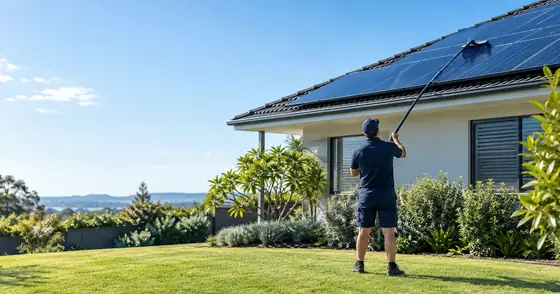
On a single storey home, a pole reaches every panel from the lawn and the job is quick. On a double storey home we bring longer carbon-fibre poles and allow more set-up time, and we only go onto the roof, clipped to an anchor, if some panels sit out of reach.
Height changes the set-up, not the method. The same pure water and the same soft brush go on the glass whether the roof is three metres up or seven. What grows with height is the time spent finding a firm, level spot for the pole, and the care taken with narrow side paths, fences and neighbours' driveways.
Single storey
The simplest job on the list. The pole reaches from the lawn or driveway, the crew never leaves the ground, and a typical array is done in about an hour.
- Access
- Pole from the ground
- Time
- About 1 hour
- Roof work
- None
- Price
- Base guide price
Double storey
Longer poles and a steadier set-up. Side paths are often narrow, so we plan where to stand before starting. If a corner of the array hides behind a dormer or a second roof plane, we explain the options before anyone goes up.
- Access
- Long pole, roof only if needed
- Time
- 1.5 to 2.5 hours
- Roof work
- Anchored, never on the glass
- Price
- Access allowance added
Steep, three storey or awkward
Very steep pitches, three-storey townhouses and panels above a neighbour's roof need a proper look before we commit. Send photos or book a short site check, and you get a straight yes or no on doing it safely.
- Access
- Assessed from photos first
- Time
- Set per job
- Roof work
- Anchor points planned in advance
- Price
- Quoted after the check
| Roof type | What we watch for | How we work |
|---|---|---|
| Concrete tile | Loose ridge caps and slippery moss | Pole from the ground; roof work only on anchors |
| Terracotta tile | Old tiles that crack underfoot | We keep off it wherever a pole reaches |
| Colorbond or metal | Slippery when wet, very hot by midday | Early start, soft-soled boots if we go up |
| Flat roof with tilt frames | Low-angle panels that hold water and grime | An extra rinse along each lower edge |
| Slate | Brittle and costly to repair | Ground work only |
Stubborn mess
How do we remove bird droppings and lichen?
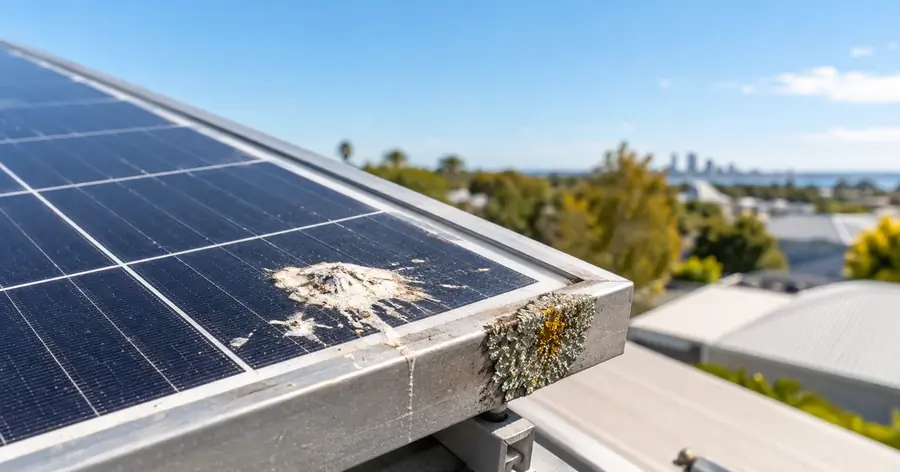
We soften bird droppings and lichen with pure water, give them time to loosen, then lift them with a soft brush, repeating as often as it takes. No scraper, blade or chemical touches the glass, because each of those can scratch or strip the anti-reflective coating.
Cleaning bird poop off solar panels is mostly a waiting game. A dropping that has baked through a hot week bonds hard to the glass, and scrubbing it dry drags grit across the surface. Wet it, wait, and it lets go.
Why bother with one or two splats? Cells in a panel are wired together in groups, so a single heavily shaded cell drags down the output of its whole group, not just its own small square. A dropping the size of a coin matters more than it looks.
Lichen is slower. It grows from the frame edge on damp, shaded roofs and can take a few soak-and-brush rounds to clear. Where it has crept under the frame lip, we photograph it and leave the seal alone rather than dig at it. Moss on the tiles below the array is a roof restoration job, so we leave that to a roofer.
Bird droppings
- Photograph each spot so the before is on record.
- Flood it with pure water and leave it to soak.
- Lift it with a soft brush, never a blade.
- Rinse the whole panel so nothing dries in streaks.
Lichen and moss
- Check the frame and seal for damage first.
- Soak the growth along the frame edge.
- Work it off with a narrow soft brush.
- Repeat on stubborn patches and note what remains under the lip.
If pigeons are nesting under the array, the report shows the nests and the mess beneath them so you can decide on proofing. Nesting material also traps leaves and damp against the cabling, which is worth knowing even when the glass looks fine.
Warranty
Will a professional clean affect your panel warranty?
A careful clean with purified water and a soft brush should not affect your panel warranty. The risk comes from damage caused by the wrong method, such as scratched glass from abrasive pads or split seals from a pressure washer, which panel makers commonly exclude from cover.
Solar Victoria tells owners to check their warranty before hiring a cleaning service, and RACV's panel cleaning advice is to work from the ground, stick with water and never use a pressure washer. Our method sits inside both. Their maintenance guide is short and worth reading.
✓What panel manuals usually accept
- Clean water, ideally low in minerals
- Soft brushes, sponges or cloths
- Gentle rinsing at low pressure
- Washing in the cool of the morning or evening
✕What they usually rule out
- Abrasive pads, scrapers and blades
- Harsh chemicals and solvents
- Pressure washers and high-pressure jets
- Cold water thrown on hot glass
- Standing or kneeling on the panels
Three ways to find your own panel manual
- Check the paperwork. The panel brand and model are listed on your installer's invoice and the system's compliance certificate.
- Look in the handover pack. Installers usually leave panel and inverter manuals with the invoice, or send them by email.
- Search the brand's website. Most publish their installation manual online; the cleaning rules sit in the maintenance section.
If your system is under an installer service plan, tell them before booking a separate clean. Some plans include a wash at each service visit, and there is no point paying twice.
Our report records the date, the water used and the brush type on your roof, which is the kind of detail a warranty claim may ask for.
Price
What does a home solar panel clean cost?
A single storey home with around 20 panels typically costs $190 to $260 to clean in Melbourne, and a double storey home with the same array usually sits closer to $230 to $310 because of the extra access time. Heavy droppings or lichen add a little more.
| Home system | Single storey | Double storey |
|---|---|---|
| About 10 panels | $130 to $185 | $155 to $220 |
| About 20 panels | $190 to $260 | $230 to $310 |
| About 30 panels | $260 to $380 | $310 to $455 |
| 40 or more | $330 to $500 | $395 to $600 |
They are guide prices for a pure-water clean in Melbourne this year, and your written quote confirms the real number before a date is booked. The solar panel cleaning cost page covers minimum charges, travel and add-ons in full.
Frequency decides the yearly spend. One visit a year suits most homes; houses under gums, beside a main road or near the bay may need two. Our guide to whether solar panels need cleaning lists the signs to watch for.
Every guide price covers the whole array, the frames and lower lips, the soak-and-brush work on droppings, and the photo report. Only unusual build-up, such as years of mess beneath a pigeon roost, pushes a quote past the range shown.
Book
How do you book a home clean online?
Send your panel count, storeys, roof type and suburb through the form and we reply by email with a fixed price, usually within one business day. Pick a morning that suits, leave the side gate open, and the report lands once we have packed up.
- 01Tell us about the roofPanel count, storeys, roof type and suburb. A photo from the street helps.
- 02Receive a fixed priceIn writing, with any travel charge listed.
- 03Choose a morningWe confirm by email the day before we arrive.
Want to attach roof photos? Use the full form on our quote request page.
Questions
What do homeowners ask us?
Three questions come up on nearly every house booking. Anything else on your mind? Put it in the access notes and the answer arrives with your price.
Ask about your roof